
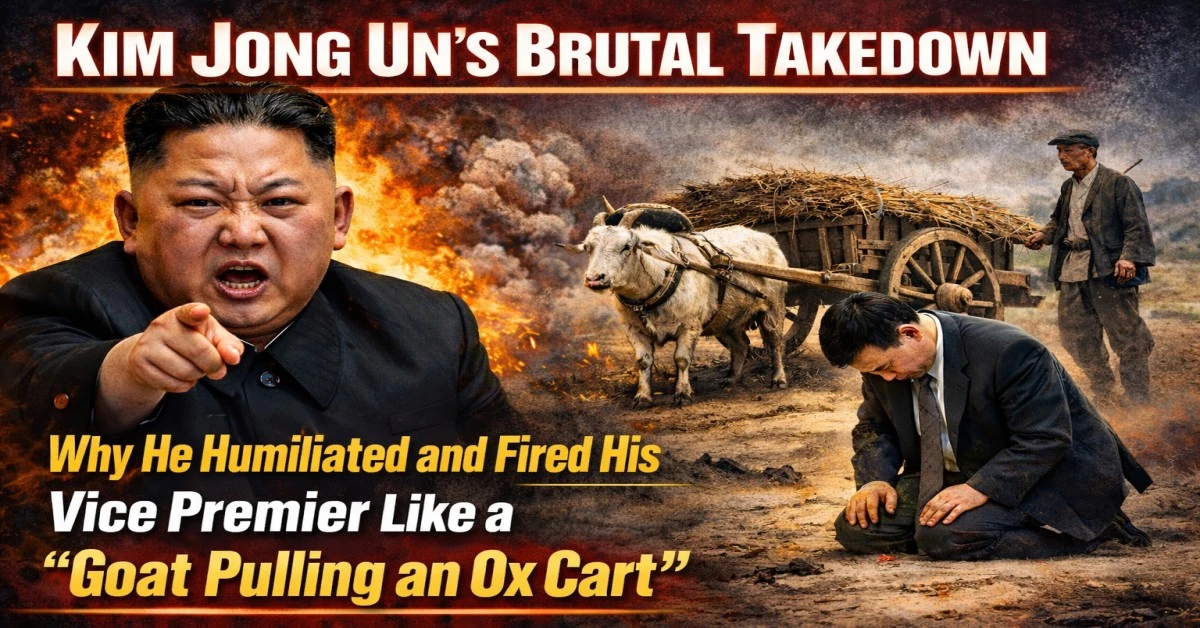
Kim Jong Un’s regime is no stranger to shocking headlines, but even by North Korean standards, the recent takedown of Vice Premier Kim Yong Jin was startlingly brutal. The supreme leader didn’t just fire a high-ranking official; he subjected him to a meticulously staged public humiliation, lambasting him as incompetent “like a goat pulling an ox cart.”
This wasn’t a simple dismissal. It was a political spectacle loaded with symbolism, fear, and a stark message to the ruling elite. At Digiparvat, we dissect global power plays. Let’s unravel the meaning behind this vivid agrarian metaphor and what it reveals about the inner workings of the world’s most secretive state.
The Incident: A Public Spectacle of Power
The scene was a national meeting on the “spiritual life” of students—a seemingly mundane topic. Yet, it became the stage for a classic Kim Jong Un power demonstration. Vice Premier Kim Yong Jin, responsible for education, was publicly scolded for “serious political failures.” State media reported that Kim Jong Un accused him of lacking “devotion and ability,” comparing his performance to “making a goat pull an ox cart.”
The imagery is deliberately vivid and insulting in an agricultural society: a feeble goat is utterly unsuited for the heavy, critical work meant for a powerful ox. The message? The Vice Premier was not just inadequate; he was a laughable, pathetic mismatch for his role. He was immediately expelled from the ruling Workers’ Party and removed from his post.
Decoding the Humiliation: Why the “Goat and Ox Cart” Metaphor?
- Reinforcing Absolute Authority: Public purges are Kim’s primary tool for enforcing total obedience. By humiliating a senior figure, he reminds every official that no one is safe. Their positions, and lives, depend solely on his whim.
- Shifting Blame & Demonstrating Control: With North Korea facing immense economic hardship and policy failures, scapegoats are essential. Sacrificing a high-profile figure like the Vice Premier allows Kim to deflect systemic blame onto individual “incompetence,” portraying himself as the vigilant leader rooting out problems.
- The Cultural Weight of the Metaphor: In Korean and many Asian cultures, the ox is a revered symbol of strength, diligence, and agricultural success. Comparing an official to a hapless goat dragging a massive cart creates a powerful, instantly understandable picture of failure that resonates deeply with the domestic audience.
- Sending a Shockwave Through the Elite: This act is not just about one man. It’s a calculated warning to the entire party bureaucracy. It signals that complacency will not be tolerated, and that Kim is watching, ready to mete out brutal punishment for any perceived slackening in revolutionary zeal.
The Bigger Picture: Instability or Strengthened Control?
Analysts are divided. Some see these frequent, dramatic purges as a sign of underlying instability and paranoia within the Pyongyang leadership. Others argue it’s a chillingly effective method of consolidating power, keeping potential rivals off-balance and ensuring that loyalty to Kim is the only currency that matters.
The firing aligns with a long-term pattern of Kim Jong Un removing older officials associated with his father’s era and installing younger, personally loyal technocrats. It may signal a renewed push to reinvigorate (or fearfully micromanage) key policy areas like education and ideology.
Historical Context: This is a Well-Worn Playbook
Kim Jong Un did not invent this tactic. His father, Kim Jong Il, was a master of the orchestrated purge. His grandfather, regime founder Kim Il Sung, also used public criticism sessions. However, under Kim Jong Un, the purges have often been more frequent and final, with officials like his own uncle, Jang Song Thaek, being executed. The “goat and ox cart” incident is a softer version of this lethal tradition, using humiliation rather than immediate violence, but the underlying message of terror remains identical.
FAQs on Kim Jong Un’s Leadership Purges
Q1: What happens to officials after they are purged in North Korea?
A: It varies. They can be simply removed from their post, sent to forced labor camps (re-education), or in extreme cases, executed. The public disgrace often extends to their families as well.
Q2: Is Kim Jong Un’s rule becoming more unstable due to these purges?
A: It’s a double-edged sword. While purges sow fear and can create hidden resentment, they also eliminate potential rivals and enforce a brutal form of discipline that has kept the regime in power for decades. Most analysts see it as a consolidation tactic, not a sign of imminent collapse.
Q3: Why does North Korean state media report these humiliations?
A: The reports are for domestic consumption. They are designed to show the public that Kim Jong Un is a strong, hands-on leader who holds even the powerful accountable, while simultaneously terrifying the elite into submission.
Q4: What was Kim Yong Jin’s actual “failure”?
A: The specific failure is rarely disclosed. It could be related to tangible failures in the education sector, ideological “impurity,” or simply being part of a faction that lost Kim’s favor. The vague charge of “political failure” allows maximum flexibility for the leadership.
Conclusion: A Regime Built on Fear and Spectacle
Kim Jong Un’s humiliation of his Vice Premier is more than a personnel change. It is a masterclass in authoritarian rule. The “goat pulling an ox cart” insult is a perfectly crafted piece of political theater, designed to demean, warn, and control.
It underscores a grim reality: in North Korea, policy expertise is secondary to absolute loyalty. The ox cart of the state lumbers forward, and Kim Jong Un ensures that anyone he deems a weak “goat” is swiftly and publicly unharnessed—a stark lesson for the next in line.
At Digiparvat, we continue to monitor the intricate and often terrifying maneuvers of global leadership. Stay informed with our in-depth analyses of power, politics, and the stories behind the headlines.
What do you think? Are these purges a sign of strength or fear? Share your thoughts in the comments below.
About the Author