
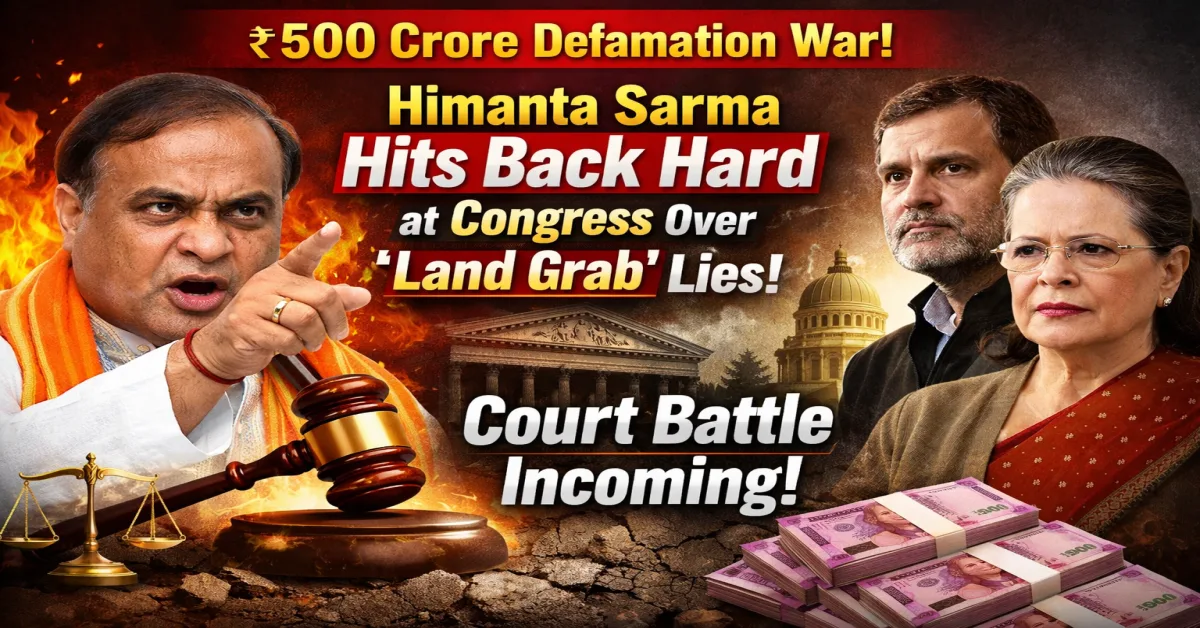
In a dramatic escalation of political hostilities in the Northeast, Assam Chief Minister Himanta Biswa Sarma has declared a no-holds-barred legal war against the Indian National Congress. The Bharatiya Janata Party (BJP) strongman has slapped a massive ₹500 crore defamation lawsuit against the opposition party, accusing it of spreading “blatant lies” regarding alleged land grabbing activities.
The development has sent shockwaves through the political corridors of Guwahati and Delhi, setting the stage for a high-voltage courtroom showdown. If you are following the intersection of Indian politics, criminal defamation laws, and BJP-Congress rivalries, this is one story you cannot afford to miss.
Here is a deep dive into the allegations, the counterattack, and what this ₹500 crore legal salvo means for Indian democracy.
The Spark: What Did Congress Accuse Sarma Of?
The legal firestorm was ignited when the Assam Pradesh Congress Committee (APCC) launched a scathing attack on CM Himanta Biswa Sarma. Through a series of press conferences and social media posts, the Congress party accused Sarma and his family members of being involved in large-scale illegal land grabbing across Assam.
Congress leaders, including state president Bhupen Borah, claimed to possess “documentary evidence” suggesting that the Chief Minister had amassed wealth and property through unlawful means. The allegations were specifically aimed at damaging the “clean image” of Sarma, who has aggressively positioned himself as a corruption-fighting administrator.
For the Congress, this was a direct attempt to corner the BJP on governance and personal integrity ahead of the 2024 Lok Sabha elections.
The ₹500 Crore Counterstrike: Sarma’s Legal Blitzkrieg
Far from staying silent, Himanta Biswa Sarma responded with surgical legal precision.
Serving a legal notice through his advocates, Sarma has demanded ₹500 crore in damages from the Congress party. The defamation suit argues that the allegations are “completely baseless, malicious, and fabricated” with the sole intent of tarnishing his 25-year-long political career.
In his official statement, Sarma remarked:
“They have crossed the Lakshman Rekha. I have never indulged in corruption or land grabbing. Since they have chosen to defame me without evidence, I will ensure they pay for every lie with their party funds.”
The defamation notice also warns of criminal proceedings if an unconditional public apology is not issued within a stipulated timeframe.
Legal Experts Weigh In: Is ₹500 Crore a Realistic Demand?
The quantum of damages—₹500 crore—has raised eyebrows across legal circles. Senior Supreme Court advocates suggest that while defamation is both a civil and criminal wrong in India, such high-value claims are often symbolic.
- Civil Defamation: Under the Law of Torts, Sarma can claim monetary damages for loss of reputation.
- Criminal Defamation: Under IPC Section 499 and 500, Congress leaders could face simple imprisonment if convicted.
However, proving malice and actual financial loss is an uphill task. Legal analysts believe the suit is designed to send a strong message rather than to recover the monetary amount.
Political Fallout: Congress vs BJP in Assam Intensifies
This defamation battle is not just a legal scuffle—it is a political watershed moment for Assam.
- For BJP: Sarma’s aggressive posturing reinforces his image as a “no-nonsense” leader who doesn’t spare even the opposition.
- For Congress: The party now faces the dilemma of either defending the allegations in court or buckling under legal pressure.
Political strategists believe this will further polarize Assam’s electorate, especially among urban voters and the middle class who value “strong leadership.”
Frequently Asked Questions (FAQs)
1. Why did Himanta Sarma file a ₹500 crore defamation suit?
Himanta Sarma filed the suit in response to allegations made by the Congress party accusing him of illegal land grabbing. He claims these statements are false and have damaged his reputation.
2. Is ₹500 crore a realistic amount in a defamation case?
While civil defamation allows for monetary compensation, ₹500 crore is largely symbolic in this context. The goal is to establish the severity of the alleged defamation and deter future baseless allegations.
3. What happens if Congress loses the case?
If the court rules in favor of Sarma, Congress may be ordered to pay damages and issue a public apology. Additionally, individual leaders may face criminal charges under IPC Section 500.
4. Has Congress responded to the legal notice?
As of now, Congress has stood by its allegations, claiming they have evidence. The party is likely to contest the suit aggressively.
5. How does this affect Assam politics?
This case is expected to dominate the political narrative in Assam. It reinforces the BJP’s “zero-tolerance” branding while putting Congress on the defensive ahead of general elections.
Conclusion: More Than Just a Lawsuit
The ₹500 crore defamation war between Himanta Biswa Sarma and the Congress is far more than a legal notice—it is a battle for political narrative in the Northeast.
On one hand, it tests the judiciary’s ability to handle high-stakes political defamation. On the other, it reflects the increasingly bitter nature of Indian politics, where allegations and counter-allegations are no longer confined to rallies and press meets, but are now fought with legal arsenals.
For Digiparvat readers, this is a developing story with massive implications for Assam’s political future, the BJP’s dominance in the Northeast, and the Congress party’s relevance in the region.
We will continue to follow the case as it moves to the courtrooms. Until then, one thing is clear: In Assam’s political arena, the gloves are officially off.
Stay updated with Digiparvat for the sharpest analysis on Northeast India politics, legal battles, and policy shifts.
Disclaimer: This article is based on publicly available statements and legal notices. The allegations and counter-allegations are part of ongoing legal proceedings, and Digiparvat does not claim to verify the factual accuracy of claims made by either party.
About the Author