
Date: February 15, 2026 | By: Digiparvat Sports Desk
In what was anticipated to be a cracker of a contest at the R. Premadasa Stadium in Colombo, the much-hyped India vs Pakistan clash in the T20 World Cup 2026 turned into a one-sided affair. In a match that had already seen plenty of drama before a ball was bowled—ranging from political tension to a boycott threat—the action on the field painted a grim picture for Pakistan cricket.
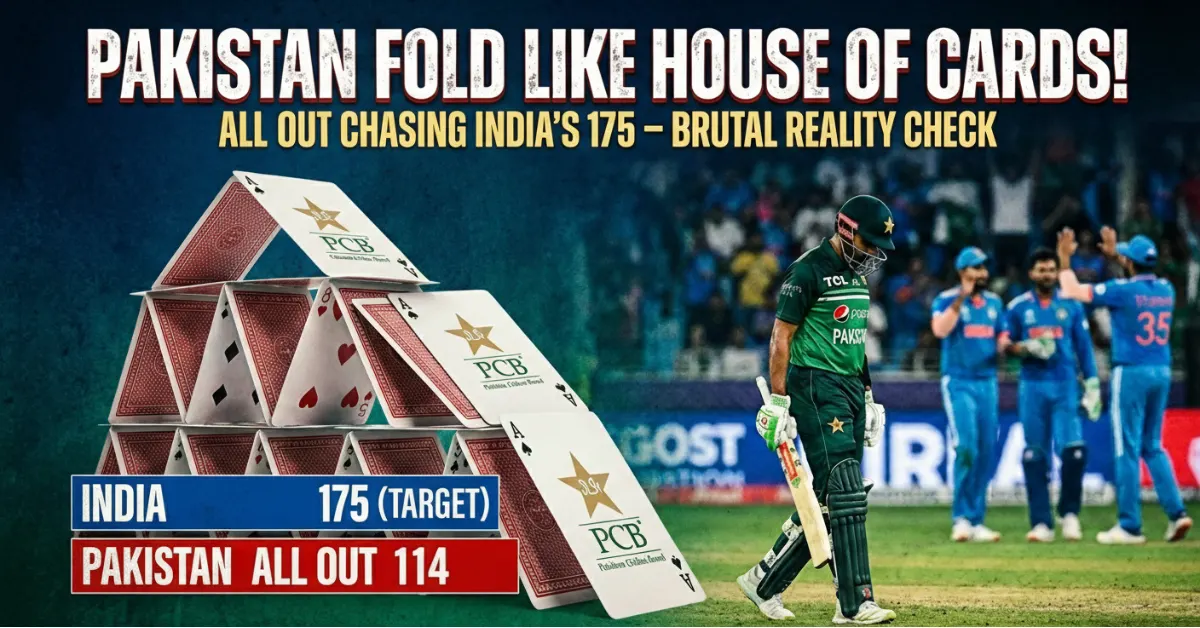
In a stunning collapse, the Pakistan cricket team folded like a house of cards, getting bowled out for a paltry 114 runs while chasing a competitive target of 175 set by India. This brutal reality check has sent shockwaves through the cricket world, raising serious questions about the team’s temperament and technique on a big stage .
The Build-Up: More Than Just Cricket
The atmosphere at the Premadasa Stadium was electric, but it was also tense. The match was given the green light only after the Pakistan government reversed its decision to boycott the game, a move that was initially made in solidarity with Bangladesh . The tension was palpable from the very first moment; at the toss, Pakistan captain Salman Agha and his Indian counterpart Suryakumar Yadav notably did not shake hands .
Agha won the toss and elected to field first, betting on a “tacky” pitch that he believed would assist his bowlers early on. Little did he know that his batting line-up would crumble under the lights against a world-class Indian bowling attack .
India’s Innings: Kishan’s Carnage and Pakistan’s Late Fight
Put in to bat, India’s innings was a tale of two halves. The Men in Blue lost Abhishek Sharma for a duck in the very first over, bowled by skipper Salman Agha himself . However, what followed was absolute destruction.
Ishan Kishan played what is already being called the knock of the tournament so far. Walking in at number three, Kishan launched a ferocious counter-attack. He signaled his intent by smashing the first ball he faced from Shaheen Afridi for a six . He didn’t just survive; he conquered the tricky Colombo pitch. Kishan raced to his fifty in just 27 balls and went on to score a sublime 77 off 40 balls, laced with 10 fours and three sixes .
Kishan found an able partner in Tilak Varma, and together they stitched a crucial 87-run partnership that laid the foundation for India’s total . Just when it looked like India would post a score exceeding 200, Pakistan found a hero in Saim Ayub. The part-time off-spinner triggered a dramatic middle-order collapse, removing the dangerous Kishan in the 9th over and then striking twice in the 14th over to send back Tilak Varma and Hardik Pandya for a golden duck .
Pakistan managed to peg India back significantly, thanks to Saim Ayub’s career-best figures of 3/25 . Suryakumar Yadav (32 off 29) and Shivam Dube (27 off 17) pushed the score to a respectable 175/7 by the end of 20 overs .
The Chase: A House of Cards Collapses
If the target of 176 was tricky, the Pakistani batting response was nothing short of a disaster. Chasing a modest total on a good surface, the Pakistani top order had no answer to the pace of Jasprit Bumrah and the spin trio of Kuldeep Yadav, Axar Patel, and Varun Chakravarthy.
The innings never took off. Wickets tumbled at regular intervals, with the batters looking completely clueless against the turning ball and extra bounce. The middle order, including the out-of-form Babar Azam, failed to forge any substantial partnerships. In a bid to keep up with the required rate, the batters played reckless shots, leading to a procession back to the pavilion. The “unbeaten” streak and the confidence from the first two wins evaporated in a matter of overs .
In the end, Pakistan were bundled out for a mere 114, handing India a massive victory. The “high stakes” clash that was supposed to be a contest turned into a brutal reality check for the Men in Green .
Analysis: Where Did Pakistan Go Wrong?
This match exposed several deep-rooted issues in the Pakistan setup:
- Over-reliance on Spin: While Saim Ayub and the spinners did a fantastic job to restrict India, the batters failed to replicate the same discipline. The Pakistani batsmen looked tentative against the Indian spinners, failing to read them from the hand.
- Tactical Blunders: The decision to bowl first on a tacky pitch backfired. While it seemed smart at the toss, the pitch eased out for batting under the lights, making the chase look much easier on paper than it was.
- Lack of Temperament: Once the required rate started climbing, the batters abandoned all cricketing sense. There was no game management, no attempt to build partnerships—just a cascade of poor shots .
- The Babar Azam Question: The debate surrounding Babar Azam’s place in the T20 side will only intensify after this game. His inability to accelerate in the middle overs continues to put pressure on the team, a topic that former cricketers like Basit Ali have vocally criticized .
Conclusion: A Wake-Up Call for Pakistan
For India, this victory solidifies their position at the top of Group A and proves that their spin-heavy strategy is a lethal weapon on subcontinental tracks. The decision to replace Arshdeep Singh with Kuldeep Yadav was a masterstroke, giving them a variety that Pakistan simply couldn’t handle .
For Pakistan, this is more than just a loss; it is a humbling experience. To go from restricting India to a chase-able total to folding for 114 is a psychological blow that will be hard to recover from. They need to go back to the drawing board, not just tactically, but mentally. As the saying goes, champions are not defined by their victories, but by how they bounce back from defeats. For now, the cricketing world will remember this as the day Pakistan’s batting line-up collapsed like a house of cards.
Frequently Asked Questions (FAQs)
1. What was the final score of the India vs Pakistan T20 World Cup 2026 match?
India scored 175/7 in their 20 overs. In response, Pakistan was bowled out for just 114 runs, losing the match by 61 runs .
2. Who was the Player of the Match?
While the official award is pending, Ishan Kishan was the top performer for his explosive 77 off 40 balls, which set up the game for India despite a late collapse .
3. Why didn’t the captains shake hands at the toss?
The captains did not shake hands due to the heightened political tensions surrounding the match. The fixture was in doubt until the last moment after the Pakistan government initially ordered a boycott of the game .
4. How did Pakistan perform with the ball?
Pakistan bowled exceptionally well to restrict India to 175. Saim Ayub was the pick of the bowlers, taking 3 wickets for just 25 runs in his 4 overs, which triggered a Indian middle-order collapse .
5. Where can I find the full match highlights?
Highlights and key moments from the match, including Ishan Kishan’s batting and Saim Ayub’s wickets, are available on the official ICC website and the broadcast partner’s platforms (e.g., BBC Sport, Star Sports) .
About the Author