
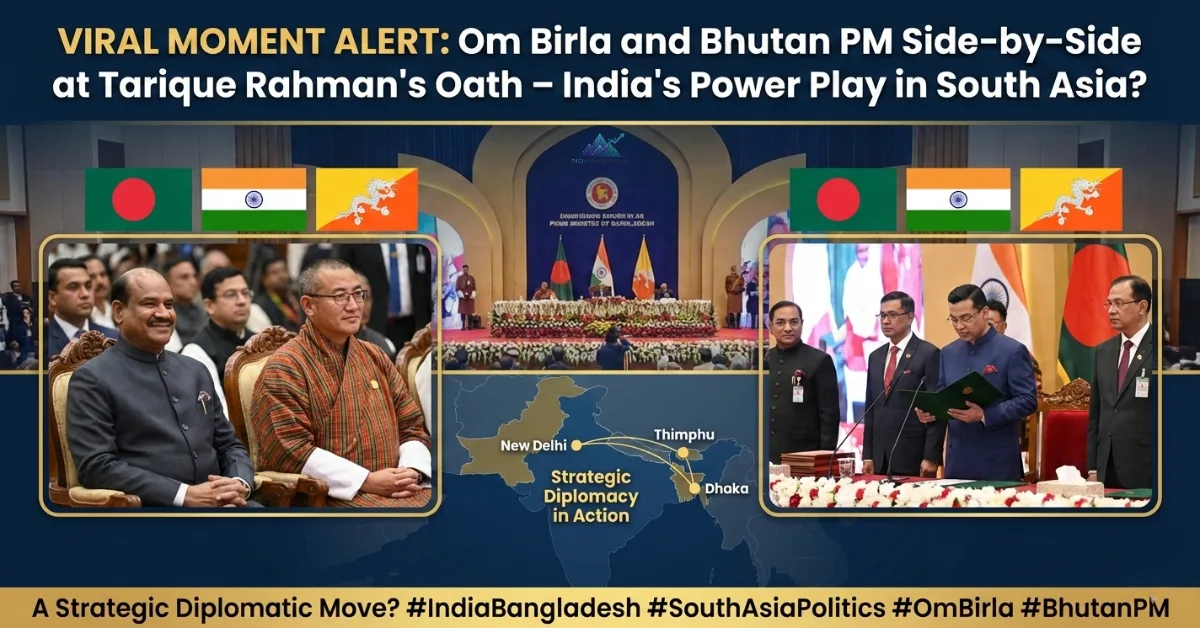
Dhaka, February 17, 2026 – A single image is going viral across South Asia today. Lok Sabha Speaker Om Birla stood shoulder-to-shoulder with Bhutan Prime Minister Tshering Tobgay in Dhaka. They watched as Tarique Rahman took oath as Bangladesh’s new Prime Minister.
Observers are already calling this a “viral moment.” But this is more than just a photo. It sends a clear message about regional power and India’s role in a changing neighborhood.
Bangladesh is entering a new political phase after years of change. The presence—and absence—of world leaders at this ceremony tells us who matters in South Asian diplomacy.
Prime Minister Narendra Modi could not attend. He had a pre-scheduled meeting with French President Emmanuel Macron in Mumbai. But India made sure its voice was heard. It sent its top parliamentary leader instead .

India Moves Fast to Build Bridges
The ceremony at the Jatiya Sangsad Bhaban was never just about a new government taking charge.
The Bangladesh Nationalist Party (BNP) won a massive victory. Now, Dhaka is rethinking its foreign policy. Tarique Rahman has already stated that Bangladesh will not focus on any single country. This marks a shift from the previous government .
India responded quickly.
Om Birla met Tarique Rahman soon after the oath. He brought a personal letter from PM Modi. The letter congratulated Rahman and invited him to visit New Delhi . This direct outreach skipped formalities and moved straight to future ties.
Om Birla shared on X after the meeting:
“I handed over a personal letter from Prime Minister @narendramodi conveying his wishes to PM Rahman and inviting him to visit India at the earliest convenience.”
Why Bhutan’s Presence Matters
Bhutan shares a special bond with India. Many see Thimphu as a key example of New Delhi’s influence in the Himalayas.
So why does the side-by-side image of Birla and Tobgay matter? It shows a visual alliance. India and its stable neighbors stand ready to work with the new Dhaka government.
The Ministry of External Affairs stated that Birla’s presence “underscores the deep and enduring friendship between the peoples of India and Bangladesh.” It also reaffirms India’s “steadfast commitment to the democratic values that bind the two nations” .
This reassurance is vital. History shows that previous BNP governments (1991-1996, 2001-2006) were often challenging for India. Issues included border tensions and concerns about insurgent groups in India’s Northeast . By sending a top leader immediately, India signals a wish to move past old problems and build a fresh, practical relationship.
New Friends, Old Friends: The Balancing Act
India’s task is not simple. The BNP has historical ties to a broader Islamic identity. The new government also invited guests from Pakistan and China.
- Pakistan’s Role: Pakistan’s Federal Minister Ahsan Iqbal Chaudhary attended . Under the recent interim government, Dhaka and Islamabad grew closer. Trade between them rose by 27% in 2024-25 .
- China’s Role: Tarique Rahman calls China a key development partner. Beijing has invested heavily in Bangladesh through its Belt and Road Initiative. China remains a major force in the region.
Tarique Rahman also wants to revive SAARC (South Asian Association for Regional Cooperation) . His father, former President Ziaur Rahman, started this regional body . Reviving SAARC could give smaller nations a collective voice. This might challenge India’s traditional bilateral ties with its neighbors.
The Real Meaning of This Viral Image
The photo of Om Birla and Tshering Tobgay is not just for social media. It shows a strategic effort. India wants to keep its “Neighborhood First” policy alive, even as regional powers shift.
What did India achieve in Dhaka?
- Direct Access: Without PM Modi present, India still secured a 20-minute meeting with the new PM right after the oath .
- A Fresh Start: By inviting Rahman to India so quickly, Modi tries to reset ties that faced strains during past BNP eras .
- A Gentle Reminder: As China’s influence grows in the Bay of Bengal, India’s presence—alongside Bhutan—reminds everyone of the deep ties that bind the subcontinent.
Conclusion
Bangladesh begins a “new dawn” under Tarique Rahman. India has made it clear it will not stand in the dark . Om Birla’s presence at the oath ceremony shows New Delhi’s flexible diplomacy. India accepts the political change while moving fast to protect its strategic goals.
For Bangladesh, the challenge is balance. The people want change. The nation also needs strong ties with its giant neighbor. If today’s events offer any clue, the India-Bangladesh relationship is entering a careful, but necessary, new chapter.
Frequently Asked Questions (FAQs)
1. Why did PM Modi skip Tarique Rahman’s oath ceremony?
Prime Minister Modi had a prior commitment. He met French President Emmanuel Macron in Mumbai on the same day. Diplomatic protocols made it hard to change this schedule .
2. Who went to Dhaka from India for the event?
Lok Sabha Speaker Om Birla led the Indian delegation. Foreign Secretary Vikram Misri joined him .
3. What did Om Birla discuss with the new Bangladesh PM?
Their meeting went well. Om Birla gave Tarique Rahman a personal letter from PM Modi. The letter congratulated him and invited him to visit India .
4. How were India-Bangladesh ties under earlier BNP governments?
Relations were often cooler. Under the BNP, issues included border security and Dhaka’s closer ties with China and Pakistan. India also faced concerns about insurgent groups finding shelter .
5. Where does Tarique Rahman stand on China and Pakistan?
He wants a “balanced” foreign policy. He sees China as vital for development. He also invited Pakistani leaders to the ceremony. This signals a move away from the previous government’s strong pro-India stance .
6. What is the talk about reviving SAARC?
Tarique Rahman wants to revive SAARC. He argues that since Bangladesh started this regional group, his government should work to bring it back. This would help improve teamwork among South Asian nations .
About the Author