
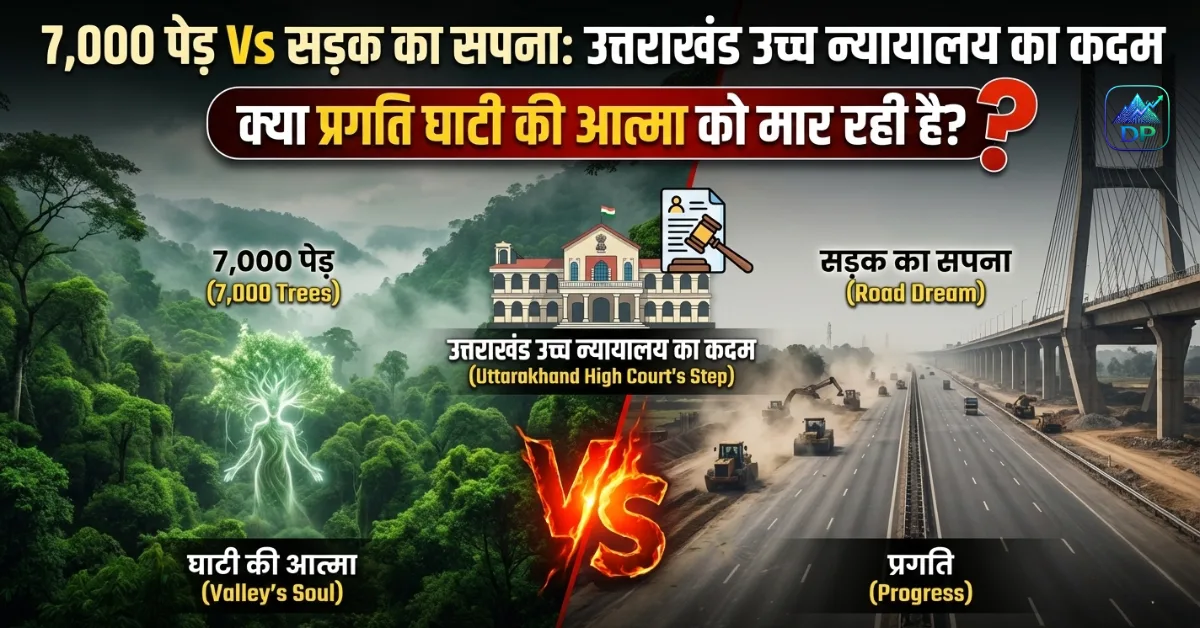
The gentle rustle of leaves in the Doon Valley is a familiar sound. However, it is now competing with the sound of gavel strikes in the Nainital High Court. At the heart of this drama lies a simple but serious question. Can we build a road to progress without destroying the soul of the valley?
The Uttarakhand High Court has stopped a major road project. The plan was to cut nearly 7,000 trees between Asharodi and Jhajhra in the Yamuna and Doon Valleys. This decision came after a Public Interest Litigation (PIL) was filed. As a result, the old debate between development and nature is back in the spotlight .
This is not just a local issue about trees and roads. It is a critical moment for Uttarakhand. It forces us to ask a real question: What does true progress look like in one of the most fragile mountain regions on Earth?
The Core Conflict: A Green Project or a Green Mask?
The project is part of the “Gatiman Green Project.” The goal is to build or widen a road to improve connectivity. However, the PIL tells a different story. It was filed by Renu Pal, a social worker from Dehradun. She claims this “green” project is harming nature .
The Allegations are Serious:
- Ecological Destruction: Cutting 7,000 trees would destroy a rich forest. This area acts as a buffer zone for elephants. It is also home to over 300 species of birds .
- Wetlands at Risk: The project threatens the Asan River catchment area. It also endangers the Asan Barrage. This is a famous Ramsar site where many migratory birds come to rest .
- Skipping the Rules: The petitioner claims the project skipped a key step. It did not get mandatory clearance from the Uttarakhand Biodiversity Board .
The High Court, led by Chief Justice Manoj Kumar Gupta, took the matter seriously. It has sent notices to the National Highways Authority of India (NHAI). Notices also went to the Union and State Governments, the Forest Department, and the Biodiversity Board. They have three weeks to file their responses .
Beyond the Headlines: The Unasked Question
The court battle is about rules and tree counts. But a bigger question remains. Is our idea of “development” outdated?
This conflict in the Doon Valley is typical of a larger problem. It affects the entire Himalayan region. For example, a recent analysis in The Hindu pointed out a key issue. Infrastructure projects in the Himalayas often ignore long-term safety for short-term gains .
Here is a breakdown of the two different visions for the valley:
| The “Road Dream” (Infrastructure First) | The “Valley Soul” (Ecology First) |
|---|---|
| Objective: Faster roads and less travel time (saving 10-15 minutes) . | Objective: Long-term safety for nature and protecting wildlife . |
| Method: Widening roads to four lanes, cutting hills, and felling trees. | Method: Smart design, fixing old roads, and avoiding fragile zones. |
| Impact: Loss of forests, broken wildlife paths, and higher risk of landslides . | Impact: Safe water sources, stable weather, and safe animal movement. |
| Cost: Quick political credit for visible “progress” . | Cost: Slower economic gains, but requires careful planning. |
A Dangerous Precedent in a Fragile Land
The Asharodi-Jhajhra project is not the only one. Environmentalists often mention the Char Dham road project as a warning. In that case, many old Deodar trees were cut. These trees have special properties. Their roots hold the mountain soil together. After they were cut, over 800 active landslide zones appeared along the widened roads .
Ashish Garg, an environmentalist from Dehradun, explains the flaw. Cutting so many trees just to save “10–15 minutes of travel time” is not wise. “In a state like Uttarakhand, which faces floods, landslides, and rising temperatures, this trade-off is very risky,” he argues .
Is There a Middle Path? Alternatives to Destruction
This is not a simple choice between roads and nature. It is about finding a new way forward. Communities and experts are asking for a balanced approach. They want plans that match the Sustainable Development Goals for mountain regions .
Here are some alternatives to cutting down forests for roads:
- Better Traffic Rules: Use one-way systems or timed traffic lights to manage jams without widening roads.
- Use Tunnels: When roads are a must, use tunnels to go under forests instead of cutting through them.
- Fix Old Roads: Spend money on making current roads strong against landslides, rather than making new, wider ones.
- Invest in People: As the UN Chronicle suggests, real progress means helping local jobs. This includes climate-smart farming, local eco-tourism, and better internet. These options let people thrive without needing roads that destroy their home .
Conclusion: The Verdict of the Future
The Uttarakhand High Court has done an important thing. It has pressed the pause button on a decision that could not be reversed. Now, the NHAI and the government must prepare their answers. They need to look beyond the legal papers. They must face the main question posed by this conflict.
The “soul of the valley” is not just a poetic idea. It is the clean water in our rivers. It is the stable air we breathe. It is the strength of our mountains. It is the rich wildlife that makes Uttarakhand Devbhoomi—the Land of the Gods. If we harm these mountains, we are not just hurting nature. We are breaking the very foundation of life for millions of people who live downstream.
The next court hearing in three weeks will be very important. But the final answer will come from the future. The children of Uttarakhand will either inherit a green, living valley or a valley covered in empty roads.
Frequently Asked Questions (FAQs)
Q1: Where exactly is the tree felling proposed?
The tree cutting is planned for a road project. It is between the villages of Asharodi and Jhajhra. These are in the Yamuna and Doon Valleys, near Dehradun .
Q2: Why has the Uttarakhand High Court intervened?
The High Court stepped in after a Public Interest Litigation (PIL) was filed. The PIL raised concerns about harm to nature. The court has asked NHAI, the Forest Department, and the government to explain their side .
Q3: What kind of wildlife will be affected by this project?
The area is full of biodiversity. It is a buffer zone for elephants. It is also home to over 300 bird species. The nearby Asan Barrage is a key spot for migratory birds .
Q4: Is development in Uttarakhand always bad for the environment?
No, not always. The key is to use sustainable methods. Experts suggest that instead of big, destructive highways, we should focus on smart traffic solutions and local jobs. These options do not require cutting down forests .
Q5: What happens next in this case?
The High Court has given the authorities three weeks to file their replies. This includes NHAI, the central and state governments, and the Biodiversity Board. The next hearing will happen after that .
About the Author