
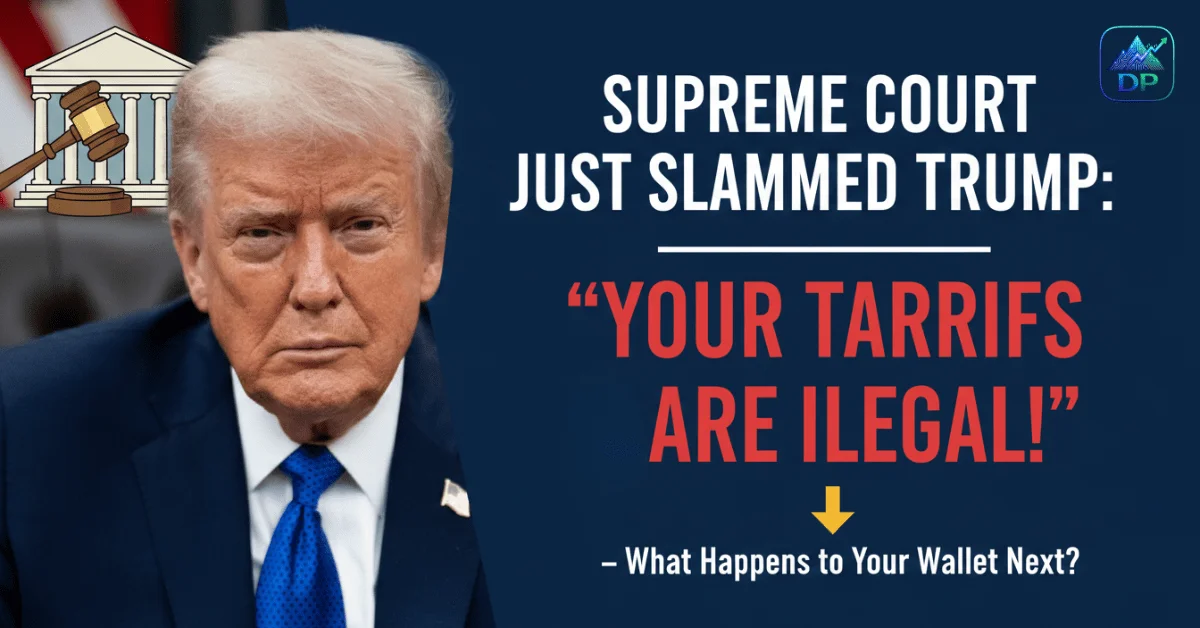
In a landmark decision that sent shockwaves through the global economy, the U.S. Supreme Court has struck down President Donald Trump’s sweeping global tariffs, ruling that the administration overstepped its constitutional authority . In a stinging 6-3 majority opinion, the nation’s highest court declared that using a 1977 emergency law to impose unlimited taxes on imports was illegal .
For months, American households have felt the pinch at the pump, the grocery store, and the electronics aisle. Now, with the court slamming the brakes on the “Liberation Day” tariffs, millions are asking the same question: What happens to my money next?
At Digiparvat, we break down the complex legal jargon into plain English. Here is exactly what the ruling means for your wallet, when you might see relief, and the looming political fight that could determine the future of your finances.
The Bombshell Ruling: Why the Court Said “No”
To understand where your money is going, you first need to understand why the tariffs were deemed illegal.
President Trump used the International Emergency Economic Powers Act (IEEPA) of 1977 to impose a baseline 10% tariff on nearly all trading partners and higher “reciprocal” taxes on dozens of nations . The argument was that trade deficits and fentanyl trafficking constituted a national emergency, granting him the power to bypass Congress.
The Supreme Court disagreed—forcefully. Chief Justice John Roberts, writing for the majority, stated that IEEEPA “does not authorize the President to impose tariffs” . He emphasized that when Congress wants to give the president tariff power, it does so “in explicit terms and subject to strict limits” .
The Slap Heard Round the World: The ruling was particularly brutal for the White House because it wasn’t a partisan decision. The liberal justices were joined by two Trump appointees—Amy Coney Barrett and Neil Gorsuch—to form the majority . Only Justices Thomas, Kavanaugh, and Alito dissented, with Kavanaugh warning that the ensuing refund process would be a “mess” .
The Immediate Impact: Your Wallet (Relief is Coming, Maybe)
This is the part that matters to you. Tariffs are essentially a tax on imports, and for the last year, American companies—and by extension, American consumers—have been footing the bill .
1. The Cost of the “Illegal” Taxes
According to data from the Yale Budget Lab and the Tax Foundation, the now-defunct IEEPA tariffs have been costing the average U.S. household between $1,300 and $1,700 in 2026 . This translated to higher prices on:
- Furniture and Clothing
- Food and Groceries
- Electronics and Cars
- Construction Materials
2. Potential Savings
If the administration simply accepts the ruling without replacing the taxes, the burden on consumers could drop by about half. Experts estimate households could save between $600 to $800 in 2026 . The average effective tariff rate—which recently hit a staggering 16.9% (the highest since 1932)—could drop to around 9% .
3. The Refund Question: Do You Get a Check?
This is the million-dollar question. Gavin Newsom and other political figures are already demanding that the administration return the money to the people, posting on X: “WHEN IS TRUMP GOING TO REFUND EVERY DAY AMERICAN PEOPLE THE $1,700 HE ILLEGALLY TAXED THEM” .
The Reality: Don’t expect a check in the mail just yet.
The Supreme Court kicked the refund issue back to lower courts to sort out . Economists estimate the U.S. government might have to refund more than $175 billion collected globally since 2025 . However, the process is archaic and will be difficult. While businesses that paid the tariffs are likely to sue for compensation, direct “dividend” checks to consumers—something Trump previously floated—are unlikely without an act of Congress .
The Loophole: Why Prices Might Not Plummet
Before you celebrate the end of high prices, there is a catch. The White House has already signaled it will use “other legal tools” to get to the “same place” .
Section 232 of the Trade Expansion Act of 1962 remains a powerful weapon in the president’s arsenal. This law allows tariffs for national security reasons. The administration has already used it for steel, aluminum, automobiles, and copper .
Experts like Gary Hufbauer of the Peterson Institute warn that if the administration shifts the tariffs to Section 232 authority, the relief for consumers will be “taken away” . Essentially, the name of the tax might change, but the price at the register might not.
What Happens Next? The Road Ahead
- The Legal Mess: Lower courts will now battle over the massive refund process. If you are a business owner who imported goods, you should consult with a trade lawyer immediately to secure your claim .
- The Political Fight: This ruling guts a core piece of Trump’s economic agenda. The President, who previously said he had been “waiting forever” for this decision, is expected to push Congress to grant him clearer tariff authority or aggressively use existing statutes .
- The Market Reaction: Stocks initially rose on the news, as investors feared tariffs would hurt corporate earnings. However, the uncertainty over refunds and replacement tariffs keeps the market on edge .
Frequently Asked Questions (FAQ)
Q: Why did the Supreme Court call the tariffs illegal?
A: The Court ruled that the International Emergency Economic Powers Act (IEEPA)—a law designed for freezing assets and imposing sanctions—does not give the president the power to impose broad tariffs. The majority opinion stated that such a massive power grab requires “clear congressional authorization,” which was missing .
Q: Will I get a refund for the extra money I spent?
A: It is highly unlikely that individual consumers will receive direct refund checks. While the government collected billions in illegal taxes, the refund process will primarily involve businesses and importers filing claims. Any relief for consumers will likely come in the form of lower prices on goods in the future, not cash back .
Q: How much money will this save me?
A: If the tariffs are not replaced, the average household could save between $600 and $800 in 2026 . However, if the administration replaces them with other legal tariffs (like Section 232), those savings might disappear.
Q: Which countries were affected by these tariffs?
A: The IEEPA tariffs were global. They targeted a 10% baseline on all trading partners, with higher rates for countries like Canada, China, Mexico, India, and Brazil, specifically targeting fentanyl trafficking and trade imbalances .
Q: Did the court rule against all of Trump’s tariffs?
A: No. This ruling specifically strikes down tariffs imposed under IEEPA. It does not affect tariffs imposed under other laws, such as Section 232 (steel, aluminum, autos) or Section 301 (intellectual property disputes with China) .
Conclusion: A Victory for the Rule of Law, But a Murky Future for Your Finances
The Supreme Court’s decision is a historic rebuke of executive overreach, affirming that the power to tax lies with Congress, not the White House . For the average American, it removes the sword of Damocles that has been hanging over household budgets for the past year.
However, the battle for your wallet is far from over. With the administration vowing to find alternative legal pathways to impose similar levies, the era of cheap goods is not guaranteed to return.
At Digiparvat, we will continue to monitor these developments. For now, breathe a small sigh of relief, but keep a close eye on Washington—because the next move from the White House could put those savings right back on the line.
About the Author