
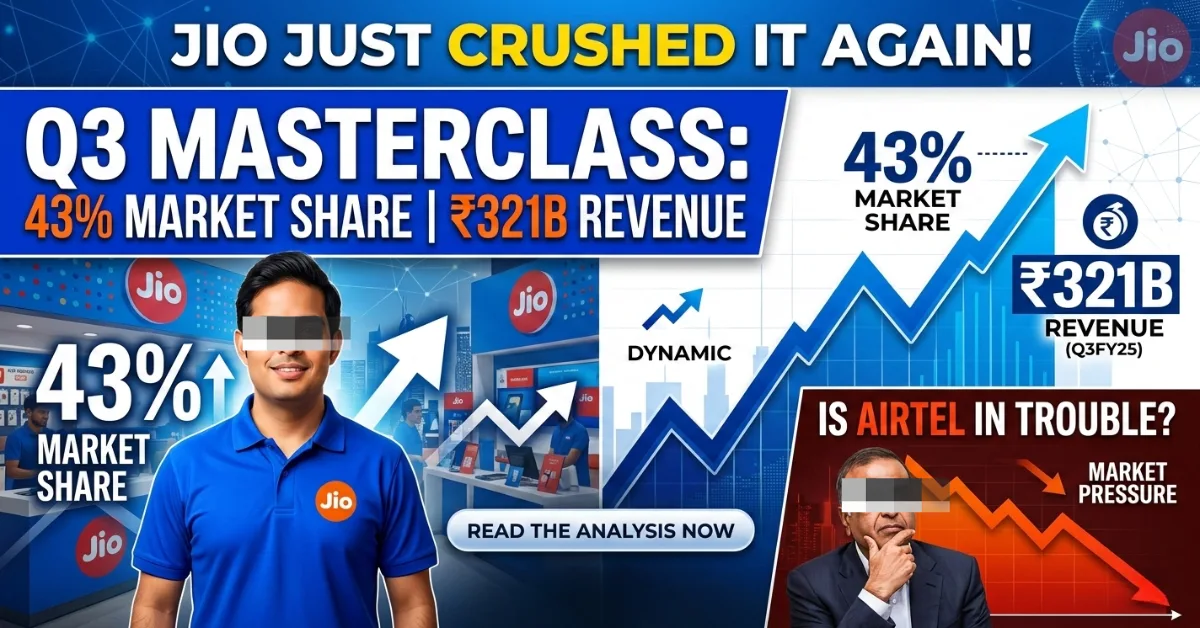
The Indian telecom battlefield has a new set of scorelines, and once again, Reliance Jio has emerged as the undisputed champion. The latest financial data for the third quarter of FY26 is out, and the numbers are nothing short of spectacular. With the gap between the top two players widening and Vodafone Idea struggling to keep up, the industry is rapidly solidifying into a classic duopoly.
At Digiparvat, we dive deep into the numbers to decipher what this means for the market, the competition, and the future of connectivity in India. Jio has not only stretched its lead but has sent a clear message to Bharti Airtel: the race for dominance is far from over.
The Staggering Numbers: 43% and ₹321 Billion
According to a recent report by ICICI Securities, Jio’s performance in Q3FY26 has been exemplary. The company’s Adjusted Gross Revenue (AGR), which includes National Long Distance (NLD), surged by 11.2% year-on-year (YoY) to a massive ₹321 billion (~$3.8 billion) .
This robust revenue growth has propelled Jio’s AGR market share to a commanding 43% . This represents a gain of 41 basis points (QoQ) and a significant 114 basis points on a yearly basis . To put this in perspective, Jio’s incremental YoY AGR of ₹32.4 billion comfortably outpaced Bharti Airtel’s ₹24.8 billion, highlighting who is driving the revenue momentum in the sector .
Competitive Landscape: The Airtel Challenge and Vi’s Struggle
While Jio is celebrating, the view from the other end of the table is mixed.
- Bharti Airtel: The “Sunil Mittal” led telco is holding strong as the number two player, reporting an AGR of ₹299 billion with a 39.9% market share . Airtel continues to be a formidable competitor, particularly in the premium segment, boasting an industry-leading Average Revenue Per User (ARPU) of ₹259 compared to Jio’s ₹213.7 . This indicates that while Jio has more users, Airtel is monetizing its high-value customer base slightly better.
- Vodafone Idea (Vi): The troubles for Vi continue to deepen. The telco posted an AGR of just ₹99 billion, with its market share slipping further to 13.3% , down 28 basis points QoQ . Analyst reports from CLSA and HSBC suggest Vi’s planned capex of ~₹45,000 crore is significantly lower than the ₹1.2-1.4 trillion expected to be spent by Jio and Airtel, raising serious questions about its ability to roll out 5G and retain customers .
Jio vs. Airtel: Q3FY26 Performance at a Glance
To better understand the duopoly, here is a quick comparison of the key metrics:
| Metric | Reliance Jio | Bharti Airtel |
|---|---|---|
| AGR Market Share | 43.0% | 39.9% |
| AGR (Revenue) | ₹321 Billion | ₹299 Billion |
| Customer Base | 515 Million | 466 Million |
| ARPU (Avg. Rev. Per User) | ₹213.7 | ₹259 |
| EBITDA Margin | 51.8% | 60.4% |
(Data compiled from Q3FY26 reports)
The Secret Sauce: 5G Dominance and AirFiber Magic
So, how is Jio managing to crush it consistently? The answer lies in execution and diversification.
1. The 5G Juggernaut: Jio’s 5G subscriber base has crossed a mind-boggling 253 million as of December 2025 . This massive adoption means that 5G now accounts for approximately 53% of Jio’s total wireless traffic . This surge in high-speed data consumption is a primary driver for revenue growth.
2. Jio AirFiber’s Record Run: Jio is not just connecting mobile phones; it’s connecting homes. Jio AirFiber has become the first Fixed Wireless Access (FWA) service globally to surpass 10 million subscribers . The total fixed broadband connected premises have reached 25.3 million . This aggressive expansion into home broadband is eating into the market share of traditional players and creating a sticky, high-ARPU customer base.
3. Metro Circle Supremacy: Jio’s growth isn’t just in the hinterlands. It posted an 18% sequential growth in metro circles, with Delhi and Kolkata seeing massive jumps of 22.9% and 24% respectively . Winning in these high-ARPU circles is crucial for profitability.
Is Airtel in Trouble? A Nuanced View
The headline question demands an answer: Is Airtel in trouble?
The short answer is no—at least, not yet. While Jio is winning the market share war, Airtel is winning the profitability war in specific segments.
- Airtel’s Strengths: Airtel’s strategy has always been focused on acquiring quality customers. Its ARPU of ₹259 is significantly higher than Jio’s, and its EBITDA margin of 60.4% is best-in-class . This financial discipline gives Airtel immense firepower to invest in networks and weather price wars.
- The Real Trouble: The real trouble is for the number three player, Vodafone Idea. The gap between the “haves” (Jio/Airtel) and the “have-nots” (Vi) is widening into a chasm. As Jio and Airtel continue to invest in 5G and premiumisation, Vi risks being left behind in the 4G era, losing subscribers to the duopoly .
Conclusion: The Age of the Telecom Duopoly
The Q3FY26 results have confirmed that the Indian telecom story is now a two-horse race. Reliance Jio, with its 43% market share and ₹321 billion revenue, has solidified its position as the market leader . By aggressively pushing 5G adoption and disrupting the broadband market with Jio AirFiber, Jio is building an ecosystem that extends far beyond voice and data.
For Airtel, the challenge is to maintain its premium positioning and high ARPU while fending off Jio’s relentless expansion. As for consumers, this duopoly means we can expect continued innovation and high-quality services, though perhaps with fewer “rock-bottom” prices as both players focus on extracting higher revenue per user.
At Digiparvat, we believe Jio’s latest performance isn’t just a win; it’s a statement. The digital revolution in India has a new emperor, and for now, the crown sits firmly on Jio’s head.
Frequently Asked Questions (FAQs)
1. What is Jio’s current market share in India?
As of Q3 FY26, Reliance Jio commands a dominant 43% revenue market share based on Adjusted Gross Revenue (AGR), solidifying its position as the largest telecom operator in the country .
2. How much revenue did Jio generate in Q3 FY26?
Jio’s Adjusted Gross Revenue (AGR), a key metric for telecom earnings, stood at a massive ₹321 billion (~$3.8 billion) for the quarter ending December 2025 .
3. How does Jio’s performance compare to Airtel in Q3?
While Jio leads in overall revenue market share (43% vs. Airtel’s 39.9%), Airtel leads in profitability metrics with a higher Average Revenue Per User (ARPU) of ₹259 compared to Jio’s ₹213.7 .
4. What is driving Jio’s revenue growth?
The primary drivers are the rapid adoption of 5G services (now with 253 million users), the expansion of Jio AirFiber (surpassing 10 million subscribers), and strong performance in metro telecom circles .
5. What is Jio’s ARPU (Average Revenue Per User)?
For Q3 FY26, Jio reported an ARPU of ₹213.7 per month, driven by higher customer engagement through 5G and fixed broadband services .
6. Will Airtel be able to compete with Jio?
Yes. Airtel remains a highly profitable competitor with strong financial discipline. While Jio leads in subscriber count and market share, Airtel leads in ARPU and EBITDA margins, making it a strong number two in a profitable duopoly .
About the Author